September 20, 2026
Artificial intelligence is moving beyond simply generating answers. The latest generation of AI models is increasingly about reasoning through complex problems, using software, doing research and completing tasks end to end. The latest step in that direction from OpenAI is GPT-6 Astra.
GPT-6 Astra was released in September 2026 and is built for complex reasoning, coding, computer use, research and professional workflows. It is OpenAI’s most capable model for end-to-end work. But what exactly is new, and how does Astra fare against established AI benchmarks?
GPT-6 Astra – A multi-step task-handling AI model that is designed to reason, rather than answer single-response questions. It can use tools, interact with the computer interface, process large contexts, and adapt when requirements change during a task.
The model has a context window of 1.05 million tokens and can generate up to 128,000 tokens, making it suitable for large documents, large codebases, research material, and long-running workflows.
That’s where Astra really hits the mark for developers, researchers, businesses and professionals who want AI to do more than just suggest.
The most important improvements to Astra are its better use of computers and software. It can perform duties like filling out online forms, updating records, web research, working with spreadsheets, website creation and software testing. Astra scored 72.6% on OSWorld 2.0, compared to 65.7% for GPT-5.6 Sol, according to OpenAI. Check out few use cases demo from the official page.
Coding is another big focus. Astra can do software engineering, terminal-based tasks, debugging, and complex code workflows. On Terminal-Bench 4.0, it scored 57.9% compared to 37.3% for GPT-5.6 Sol.
And Astra also shows big gains in advanced reasoning. Its larger context window allows it to work over large amounts of information and to keep track of context over longer tasks.
Benchmarks provide a useful way to compare AI capabilities, although no single benchmark can measure overall intelligence.
| Benchmark | GPT-6 Astra | What It Measures |
| ARC-AGI-3 | 99.9% | Abstract reasoning |
| FrontierMath Tier 4 | 97.6% | Advanced mathematics |
| GPQA Diamond | 96.0% | Graduate-level science |
| Terminal-Bench 4.0 | 57.9% | Coding and terminal tasks |
| OSWorld 2.0 | 72.6% | Computer use |
| ScreenSpot-Pro | 92.7% | Interface understanding |
| ExploitBench | 100% | Cybersecurity capabilities |
OpenAI reports that Astra reaches 99.9% on ARC-AGI-3 and 97.6% on FrontierMath Tier 4. It also achieves 96% on GPQA Diamond, a benchmark covering graduate-level questions in areas such as biology, chemistry, and physics.
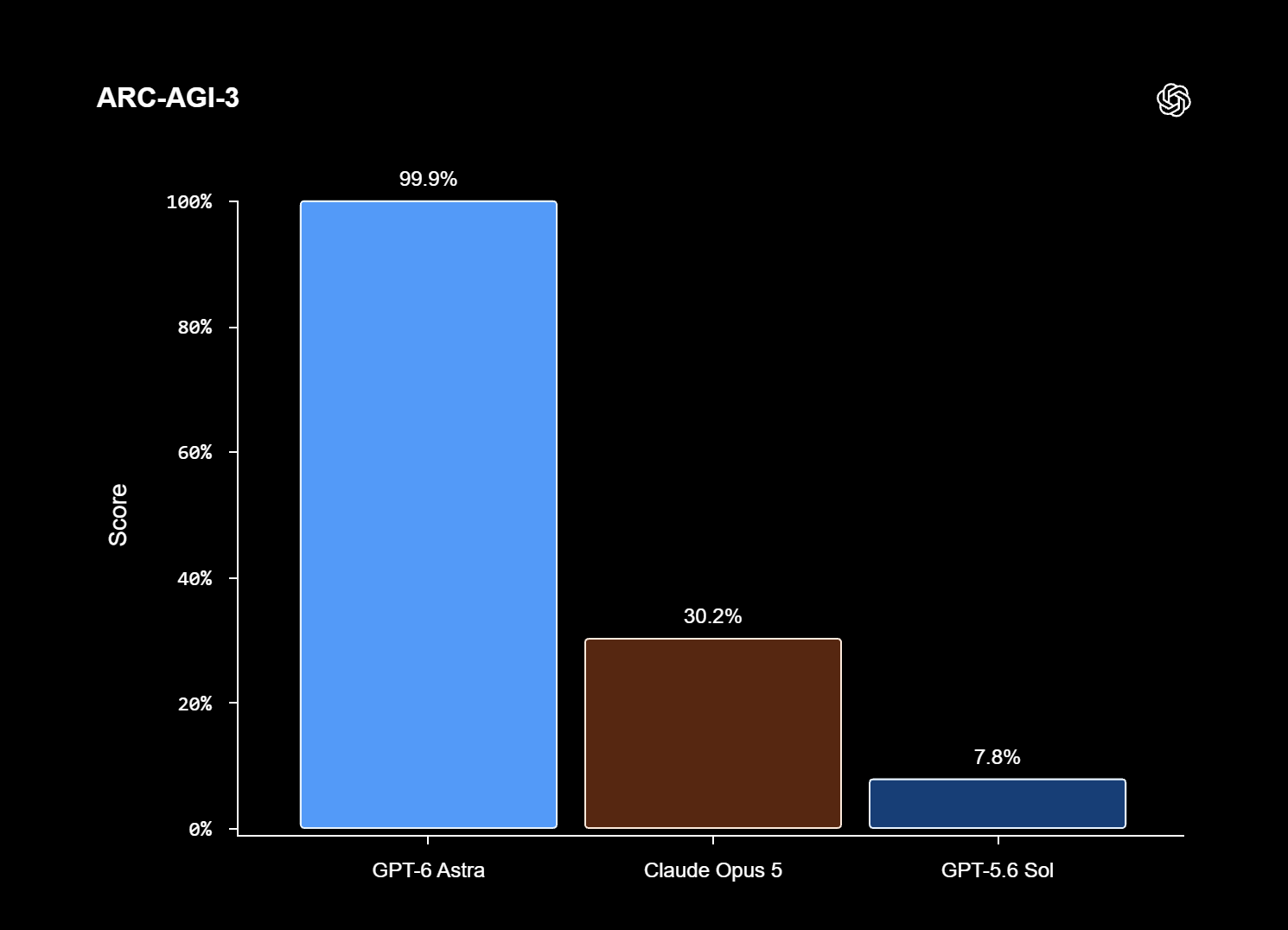
ARC-AGI-3 Benchmark
However, Astra does not lead every benchmark. For example, on Humanity’s Last Exam with tools, Claude Fable 5.1 scored 65%, compared with Astra’s 57.2%. This highlights why benchmark results should be viewed individually rather than as a single universal ranking.
Benchmarks show the difference more clearly when Astra is compared with GPT-5.6 Sol.
On Terminal-Bench 4.0, Astra gets 57.9% and Sol 37.3%. OSWorld 2.0 scores are 72.6% and 65.7%, respectively. Astra also scores 92.7% in ScreenSpot-Pro, versus 76.9% for Sol.
Another important point is speed. OpenAI said Astra finished OSWorld 2.0 tasks in about 40 minutes in its latency simulation, compared to about 75 minutes for GPT-5.6 Sol.
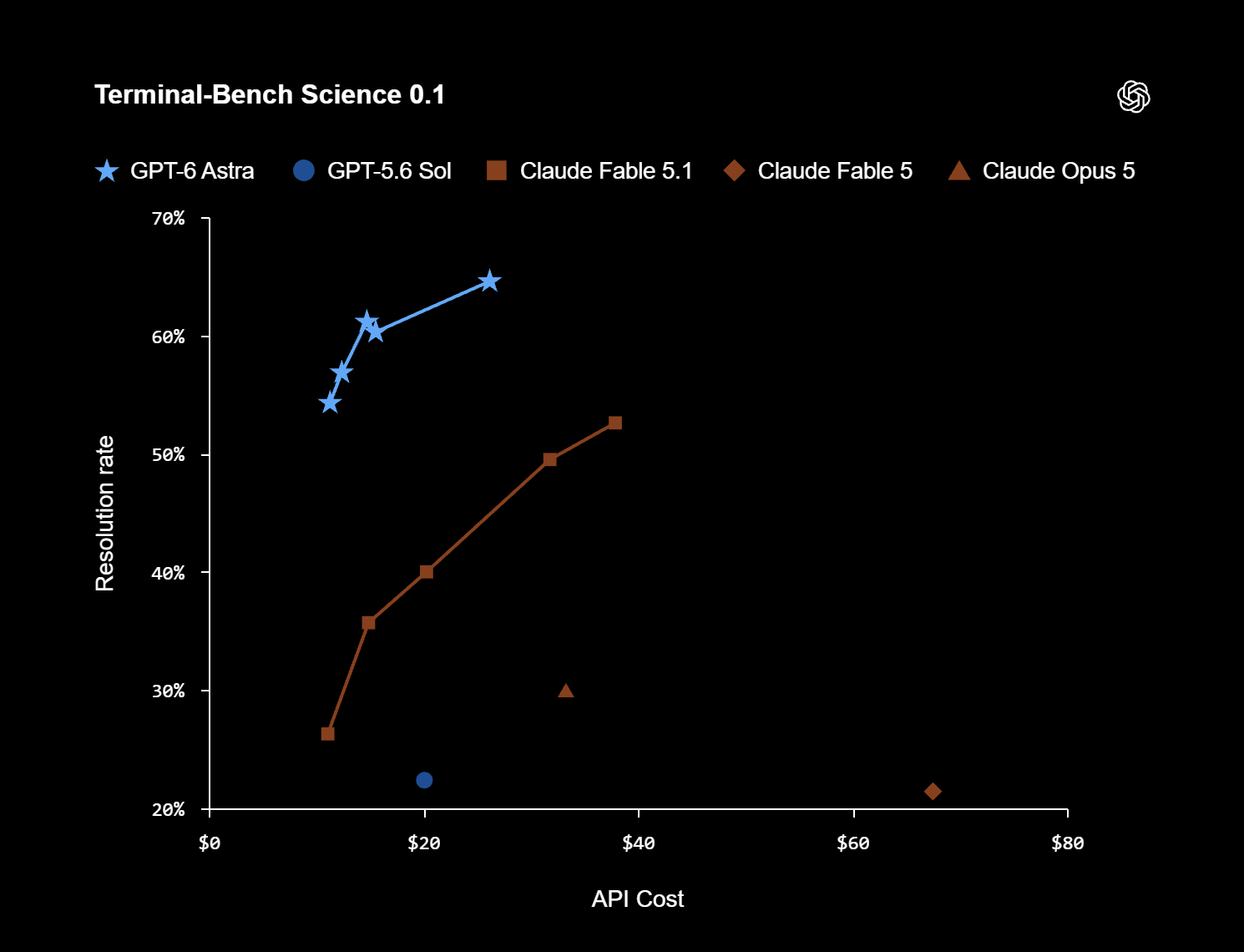
I think for developers, scores that show coding skills could mean that developers get better help when building complex software projects. For researchers, scores that show reasoning and long‑context abilities can help researchers analyse large amounts of data. For businesses, scores that show computer use can make AI‑driven workflow automation more practical, for businesses.
Still, scores should not be treated as a guarantee of real‑world performance. Each score measures a specific skill, and results can depend on the tools used, the prompts, the evaluation settings and other factors.
GPT-6 Astra is a change in the direction of artificial intelligence systems that can think, work with programs and finish complicated jobs instead of just creating answers.
In many areas, its results in thinking, writing code, and tests are much better than GPT-5.6 Sol. However the performance of the test results changes depending on the task, which means the best model depends entirely on what the person wants it to do.
The important part of GPT-6 Astra may not be any one number. It is the change from intelligence that answers questions to artificial intelligence that can do actual work.